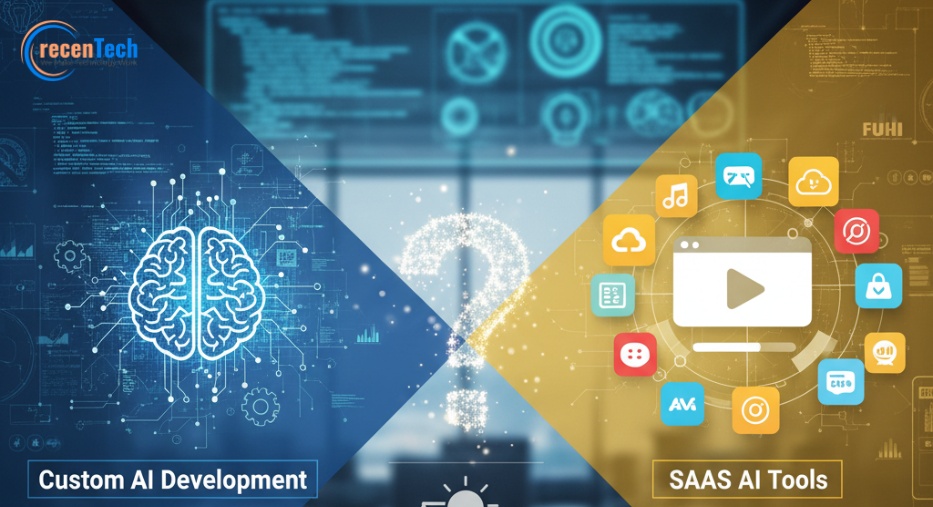
A custom-build solution provides the scalability and customization you need to stay ahead if your company is focused on long-term control, scalability, and competitive advantage. However, SaaS tools offer a flexible and low-risk way to start if your immediate goals are speed, cost savings, and operational convenience.
Businesses are constantly under pressure to implement more intelligent digital solutions, and whether to use SaaS AI tools or invest in custom AI developaBusinesses are constantly under pressure to implement more intelligent and effective digital solutions as technology advances. However, the question of whether to use SaaS AI tools or invest in custom AI development continues to be at the top of the list when it comes to integrating AI solutions across workflows.
ment stays at the top of the list. Both serve different purposes and have huge potential — aligning your roadmap with your vision and operational maturity matters as much as budget.
Although they serve different purposes, both options have huge potential. SaaS AI tools provide ease of use, reduced costs, and quicker deployment. On the other hand, custom AI development offers control and scalability. Aligning your technology roadmap with your vision, infrastructure, and operational maturity is just as important as budget when choosing between the two. You should also identify how each approach propels your business goals and creates a plan that promotes rather than limits growth.
Exploring the Two Options
The most important thing is to understand how custom AI development differs from SaaS-based AI tools and why that difference matters before delving into cost or scalability.
Custom AI development includes creating a customized solution from the ground up. It is especially made for the workflows, performance goals, and data ecosystem of your business. Each module is designed to solve problems specific to your company, providing accuracy that is simply unmatched by SaaS AI tools.
SaaS AI tools are subscription-based platforms made for quick integration and user-friendliness. They are perfect for teams that require rapid automation or analytics without a complex technical setup because they are designed to be widely accessible. Consider the difference between renting a suit that fits well enough and owning one that is specifically made for you.
How Custom AI Development Helps Businesses
Control, security, and long-term adaptability are key components of custom AI development. It gives businesses the ability to create solutions that directly address their operational challenges, from data collection to decision-making.
- Full Control: Each component can be customized to the goals, logic, and data architecture of your company.
- Data Security: You maintain compliance and privacy by deciding where data is stored and who can access it.
- Scalability: The solution adapts to changing needs and grows with it.
- Competitive Advantage: Custom solutions can provide your business with a special capability that cannot be achieved by SaaS AI tools.
Custom AI development becomes more than just an investment for industries like manufacturing, finance, and logistics where accuracy and data sensitivity are important. However, businesses should be ready for a longer development period and the requirement for specialized technical knowledge.
When SaaS AI Tools Make More Sense
Every time businesses don’t have to start from the beginning. Many people find that SaaS AI tools offer an effortless way to incorporate intelligence into routine tasks without interfering with current systems.
- Quick Implements: Teams can quickly see quantifiable results with most SaaS platforms, which can be deployed in weeks.
- Cost-Effectiveness: Subscriptions enable predictable monthly or annual spending, negating the need for a huge investment.
- No Maintenance Required: Updates, bug fixes, and feature enhancements are managed by the vendor.
- User-Friendly: Non-technical users can easily adopt these tools because they are designed with simplicity in mind.
However, there are often trade-offs associated with SaaS models. Long-term data control and flexibility may be impacted by limited customization, vendor lock-in, and reliance on external servers.
SaaS tools can be a wise first step for startups or small businesses, but they may eventually outlive their usefulness as data volume and complexity increase.
How to Make the Right Choice
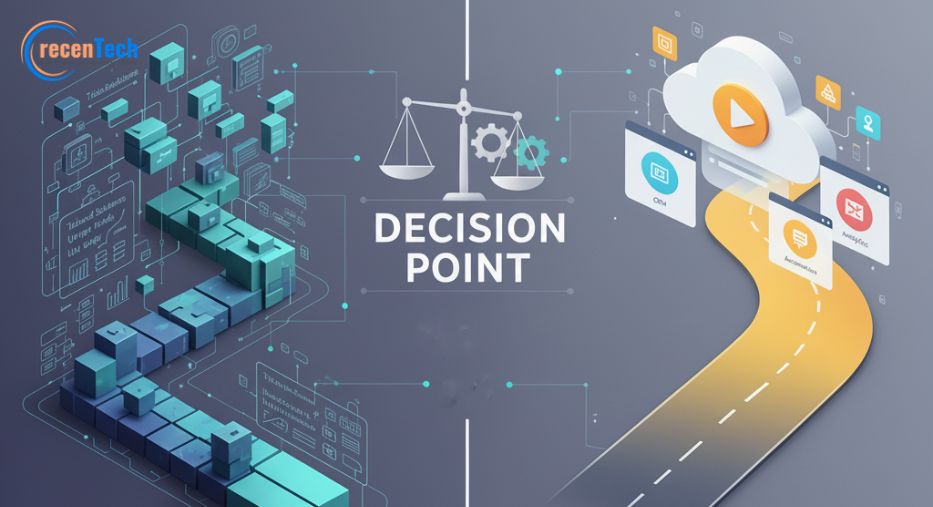
Here’s how both strategies compare across key factors to make your decision easier:
| Criteria | Custom AI Development | SaaS AI Tools |
|---|---|---|
| Setup Time | Longer, depends on scope | Quick and ready to use |
| Cost Model | High initial cost, long-term savings | Lower initial cost, ongoing subscription |
| Control | Full control over design & data | Limited flexibility |
| Scalability | Unlimited, tailored to business growth | Depends on vendor capabilities |
| Data Ownership | Fully owned by your organization | Often shared with provider |
| Maintenance | Managed internally or by partners | Fully handled by the vendor |
For established businesses with clear data strategies, custom AI offers control and flexibility. SaaS tools are ideal for businesses that prioritize cheaper and speedy solutions.
Hybrid Model
A lot of progressive businesses are using a hybrid approach. To test capabilities, collect data, and assess impact, they begin with a SaaS AI solution. They move toward custom AI development to ensure complete control once they find gaps or scalability requirements.
This strategy creates a balance between creativity and pragmatism while reducing risk. By combining the depth of custom systems with the power of SaaS tools, it enables businesses to progress rapidly and assures that they are always prepared for the future.
Final Words
The distinction between SaaS AI tools and custom AI development is more about strategy than technology. Your priorities will determine which option has the greatest potential to improve business performance.
A custom-build solution provides the scalability and customization you need to stay ahead if your company is focused on long-term control, scalability, and competitive advantage. However, SaaS tools offer a flexible and low-risk way to start if your immediate goals are speed, cost savings, and operational convenience.